
Monsters and Madonnas

How the "Antichrist" Ended Up Photographing the Madonna
This picture came back to me many times: a woman in a veil, eyes closed, lifting a white dove to her lips — all grain and shadow, a touch of medieval tenderness, like something pressed between the pages of an old prayer book. I thought it was a nun.

It is actually from 1926. The woman is the Australian actress Dorothy Cumming, playing the Virgin Mary in Cecil B. DeMille's silent epic The King of Kings. And the photographer was a man named William Mortensen — and once I started pulling the thread, the story turned out to be far stranger than the picture. It involves a missionary filmmaker, a photographer that the occult world would later claim as its own, and the most famous feud in the history of photography.
The Film
The King of Kings told the last weeks of Christ, from Mary Magdalene to the resurrection. It was the middle film of DeMille's biblical trilogy — The Ten Commandments (1923), then this, then The Sign of the Cross (1932) — and he made it on a scale that's hard to imagine now: thousands of extras, sets the size of temples, and two sequences (the opening and the resurrection) shot in early two-colour Technicolor while the rest was tinted sepia and gold. I love that touch.
DeMille was a devout Episcopalian who genuinely thought of himself less as an entertainer than as a kind of missionary with a camera. His father had been a lay preacher who read the family a chapter of the Bible every night, and DeMille grew up treating Scripture as the greatest story available to anyone. He called the life of Christ the one subject worth all others.

But he was also a showman. Hollywood in the 1920s was drowning in scandal, and the public increasingly saw the movies as a moral sewer (nothing new under the sun). A reverent, enormous film about Jesus was, among other things, a clever way to buy the whole industry some respectability. DeMille had a working theory he applied to most of his films: lure people in with a little glamorous sin, then redeem it by the end. The King of Kings opens, accordingly, with Mary Magdalene as a wealthy courtesan (a deliberately lavish, slightly scandalous scene) precisely because DeMille wanted to catch the sceptics before converting them. Not that I’m onbard with that, but I think maybe he saw as the only way forward.
On set, though, he took the holiness seriously. He had clergy lead prayers each morning before filming. And he went to remarkable lengths to protect the image of Christ: H. B. Warner, the actor playing Jesus, was kept apart from everyone, driven to set in a closed car, and made to eat alone, so the crew would only ever see him in dignified character. The man playing God was, in effect, put under house arrest for the good of the picture…
Which brings us to Dorothy Cumming: to play the Mother of God, Cumming signed a contract in 1926 that governed her private life for seven years, including a clause forbidding her to divorce. The studio's logic was simple: nothing could be allowed to tarnish the woman audiences would see as the Virgin Mary. By various accounts the contract also kept her out of nightclubs, card games, and even open-top cars, though those particular details are repeated more confidently online than the sources strictly support.
The seven-year morality clause is real, though, and we know it is real for an ironic reason. It surfaced publicly during Cumming's divorce trial. She divorced anyway. The only proof that she promised, on paper, to stay married for the sake of playing the Blessed Virgin is the court case in which she didn't.
The Photographer
DeMille hired William Mortensen to shoot the stills, and what Mortensen did changed the job permanently.
Until then, "production stills" were faked after the fact: actors hauled back to pose stiffly once the real scene was done. Mortensen ignored the convention and photographed the actors live, in motion, during the actual filming. The results were so good that his method became the Hollywood standard.
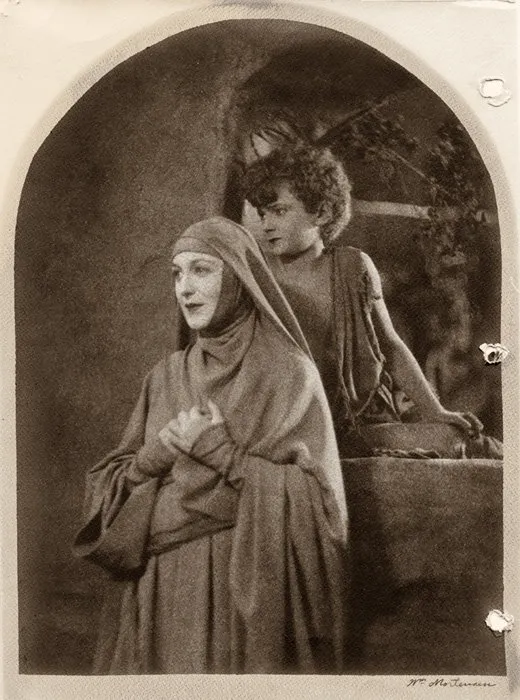
Over the shoot, he made nearly five thousand images (or so we are told), and DeMille was impressed enough to commission a private book of them — a leather-bound edition of just fifty copies. Mortensen liked to claim that one of those copies ended up in the library of the Vatican. It's a great story; it may even be true; but it traces back mostly to Mortensen himself, who was not above improving a story. (What is documented is that only a handful of copies survive in public collections, one of them at the Museum of Fine Arts, Houston.)
Now, the thing that makes Mortensen a polemic topic: he was a Pictorialist — he believed a photograph was no more sacred than a drawing, and that the negative was only the raw start. The real work, he said, happened afterwards, in the darkroom, where he attacked his prints with razor blades, pumice, paint, and textured screens until they looked like etchings or charcoal sketches. He was doing, with blades and chemicals in the 1920s, more or less what people now do with Photoshop. The resemblance is not lost on modern critics, which is part of why he's been rediscovered.
Saint-maker, monster-maker
Here's the twist: the same hands that made that tender Blessed Virgin also made some of the most lurid images of the era: witches, demons, the macabre, an enormous series illustrating a pictorial history of witchcraft. He even gathered his work under a title that says it all: his book Monsters and Madonnas.
So was he some kind of devil-worshipper? No. By every reliable account Mortensen wasn't an occultist, a magician, or, despite the Marian portrait, a notably religious man at all. He approached the sacred and the satanic the same way: as a showman and an amateur “psychologist”. He was fascinated by images that grab the primitive part of the brain — fear, desire, awe — and the occult was simply a rich supply of those. He spent months reading in the esoteric library of the mystic Manly P. Hall, not to practise anything, but to mine it for pictures.
And, to his credit, he was clear that he wasn't celebrating evil. He argued that by giving fear and darkness a face, "we are enabled to lessen their power over us" — that dragging the nightmare into the light made the daylight matter more. Goya and Bosch had done the same thing centuries earlier; Mortensen just did it with a camera.
The irony is that real occultists took him at more than his word. Decades later, Anton LaVey — the satanist guy — folded Mortensen's theories about manipulating the human gaze into his own ideas, hung a Mortensen photograph in his San Francisco house, and named him in the dedication of the satanic bible. A theatrical Hollywood craftsman, playing dress-up with darkness, ended up cited as a genuine influence on modern satanism. I can't help wondering whether gifts are ever spiritually neutral. Mortensen never seems to have intended his work as an endorsement of evil, yet history has a strange way of showing how beauty, talent and imagination can be pulled toward very different ends depending on what they ultimately serve.

The Antichrist feud
If one nickname followed Mortensen for life, it came from his great rival: Ansel Adams.
Adams — the man of Yosemite and the Grand Canyon — stood for the exact opposite of everything Mortensen did. He helped found Group f/64, the lovers of "pure" photography: razor-sharp focus, no manipulation, the camera as an honest witness to reality. Adams even built a whole technical method, called the Zone System, around precise, faithful exposure, and used his pristine wilderness images as ammunition to help expand America's national parks. For him, an untouched photograph was something close to sacred — his own spirituality was a kind of God-in-nature reverence, the divine glimpsed in a mountain.
So Mortensen's scratched-up, painted-over, demon-haunted prints struck Adams as a desecration of the medium itself. He took to calling Mortensen "the Antichrist." A bit dramatic, in my opinion, but I can understand where he is coming from. Mortensen produced such grotesque work that had never been seen by the public. The contempt ran deep: in one private letter, when a friend mentioned photographing a corpse, Adams cheerfully replied that his only regret was that the corpse wasn't Mortensen. :(
Adams won. Not the argument, exactly — but the history. He and his circle were close to the people who wrote the books and curated the museums, and over the following decades Mortensen was quietly erased from the official story of photography, until by the 1980s he was barely a footnote. He only came back when the digital age made his "cheating" look like prophecy.
What happened to all of them
The King of Kings itself became one of the most widely seen films about Jesus ever made — the first movie ever shown at Grauman's Chinese Theatre, and for decades after, the version of the Gospel that missionaries carried to villages around the world. It was not innocent, it had bits of fiction, and in its time it drew real criticism for antisemitic content (well, well, welllll…). The studio cut it heavily and withheld it from several countries before release.
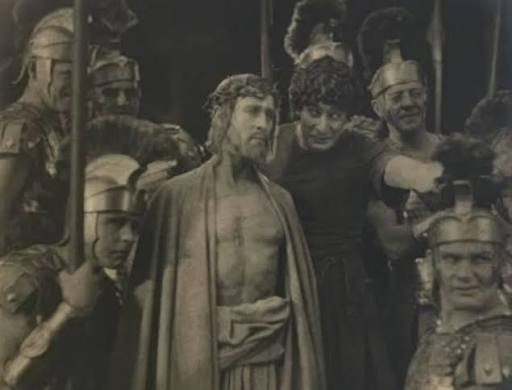
DeMille, once the most powerful director alive, slid into the footnotes too, as silent epics fell out of fashion and Hollywood drifted away from explicitly religious filmmaking. Mortensen taught, wrote, and died largely forgotten in 1965. Adams became one of the most beloved artists in American history. Dorothy Cumming's career ended, like so many, with the arrival of sound.
But then, here I am, in this era, finding some sort of comfort in her picture on Pinterest.
A small thought to end on
What keeps me circling this story isn't the scandal or the feud, or the occult claiming Mortensen, previously cherished by a Christian movie director…
Here are two men who could not have been more opposed: one chasing the divine up a mountain in perfect focus, the other dragging it out of the shadows with a razor blade. And both of them, without quite meaning to, kept making images that point past themselves toward something holy. Neither was a saint, nor did they want to be. One was claimed by satanists; the other was a self-righteous genius who wished his rival dead. I mean, it’s pretty dark, and still, between the two of them, we got a luminous Madonna and a body of work that helped save the wilderness.
Perhaps Saint Augustine would sigh: “all truth is God’s truth”. That which is true will remain, as the Rock of Ages, unchangeable.

Creativity, I've come to think, is borrowed. Like everything else, really. None of us makes anything we weren't first given the capacity to make. And light seems perfectly willing to use whatever hand is nearest — the devout one, the doubting one, even the hostile one — and to show itself either through people or, when it has to, straight against their will.
Then, they can choose. Yes, as crazy as this might sound, we can always choose. And if they didn’t choose right, that is a shame; but the man they called the antichrist made a portrait of the Mother of God, and I don't think that's a contradiction; I think that's just how grace tends to work. It gives me hope, the way God’s grace cuts through darkness.
“And where sin abounded, grace did more abound.”

--
Sources & further reading
"William Mortensen's The King of Kings" — Museum of Fine Arts, Houston: https://www.mfah.org/collection/king-of-kings
"The Photographer Who Ansel Adams Called the Anti-Christ" — Smithsonian Magazine: https://www.smithsonianmag.com/arts-culture/photographer-who-ansel-adams-called-anti-christ-180953525/
"The Antichrist in Hollywood: William Mortensen" — MUBI Notebook: https://mubi.com/en/notebook/posts/the-antichrist-in-hollywood-william-mortensen-and-his-photography-of-the-grotesque
"Photography's First Superstar" (LaVey, Manly P. Hall, the occult tail) — Book & Paper Fairs: https://www.bookandpaperfairs.com/blog/2019/3/2/photographys-first-superstar-the-work-of-william-mortensen-on-display-at-ny-ephemera-fair
"William Mortensen: American Grotesque" (the Satanic Bible dedication) — Hyperallergic: https://hyperallergic.com/william-mortensen/

Comments